The Blue Sustainability and Society Initiative (BSSI):
A Conceptual Manifesto
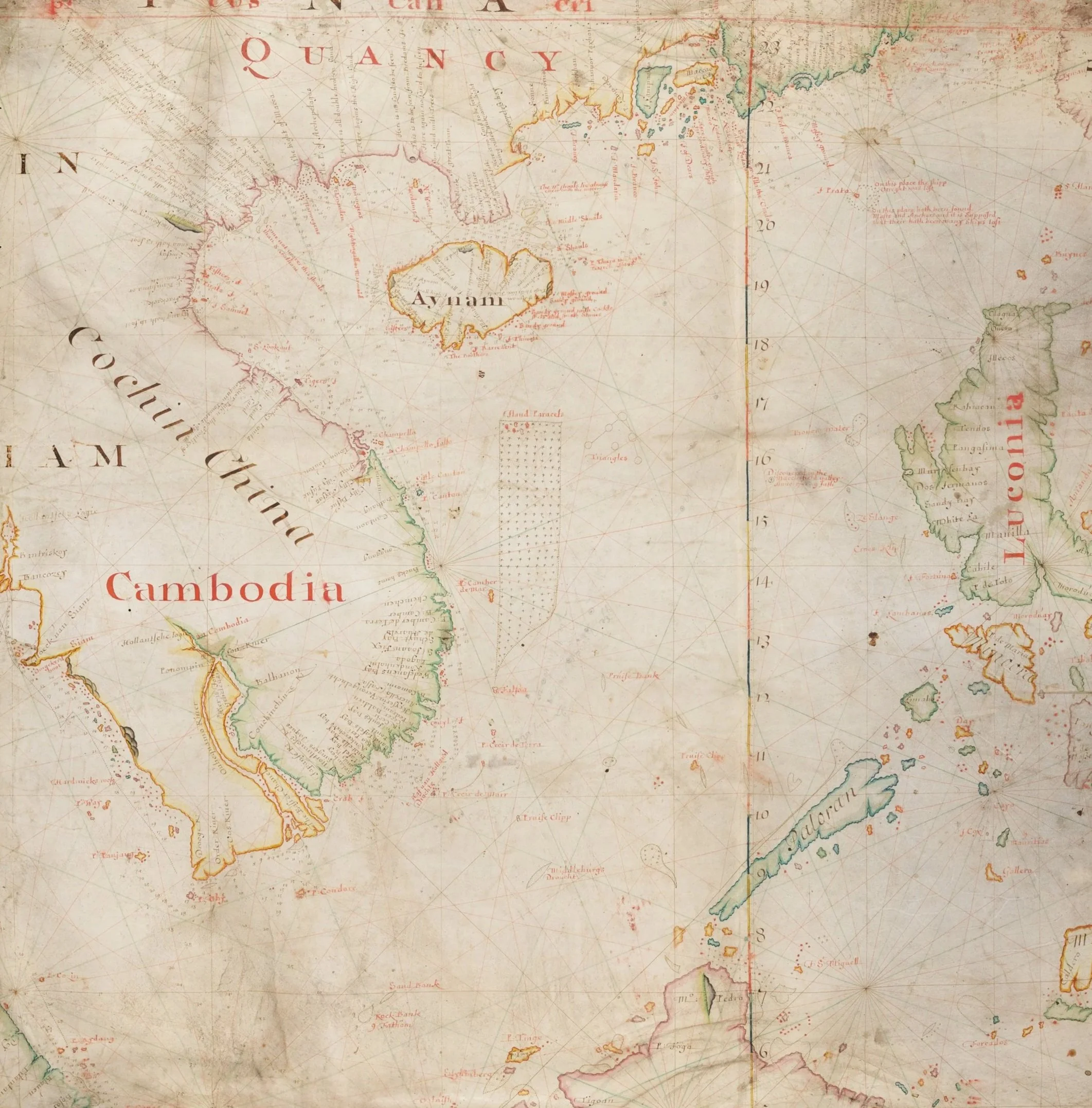
Bodleian Library MS D1 (185) [5], Image: Bodleian Libraries, University of Oxford. © Bodleian Libraries, University of Oxford. CC BY-NC 4.0.
i. Why Blue Sustainability Requires History
The Blue Sustainability and Society Initiative (BSSI) approaches problems of the sea from the understanding that crises about ocean resources are not only environmental or technical problems, but historical ones. Well before “sustainability” or “climate change” were modern mantras, people around the world conceived of marine abundance and scarcity differently, who had access to marine resources differently, how ocean spaces ought to be governed differently, and how humans and states should be made accountable for extracting marine resources differently. These conceptions shaped how communities used the sea and how they thought about using it. They continue to shape assumptions about what the sea can provide to humans and what it can endure.
Questioning the past can help us understand how ideas and practices surrounding the extraction of sea resources, eating fish, and governing ocean spaces became normalised. Overfishing, hyperactivity, depletion and coastal transformation did not suddenly arise in the twentieth or twenty-first centuries. They were normalised gradually through learnt behaviours, imperial ideologies, market forces and knowledges that perceive the sea to be infinitely abundant, beyond human jurisdiction or undeserving of political attention. BSSI therefore uses history as more than background context, but as an analytical tool to understand how we came to face these crises.
ii. Why the Past Still Matters: Responding to the “We Survived Anyway” Objection
One argument that is sometimes raised against studying sustainability in the past is that “people have been putting pressure on their environments in the past but they managed to survive.” If people in the past dealt with similar levels of environmental strain than we see today, then maybe we should not worry about it? BSSI turns this argument on its head.
Survival is not sustainability. Examples abound through history of civilizations surviving for centuries while slowly poisoning their life support systems. Harm was often postponed instead of prevented, outsourced instead of eliminated – pushed into the future, onto the edges of society, onto colonial hinterlands, or onto other species. Stability in hindsight was often actually a period of protracted crisis in which red flags were seen but accepted as normal, unnoticed, or too politically difficult to address. Today, this underlying instability has come to a head and can no longer be ignored.
iii. What Sustainability Means in BSSI
Sustainability, therefore, is not understood by BSSI as maintenance of a hypothetical ecological balance, nor as the endless perpetuation of the status quo. Rather, sustainability is seen as the historical relationship between society and the sea. As such it has been defined by cultural values, shaped by social and political organisations, molded by economic imperatives and sea stories. In this context sustainability prompts us to ask:
Who had access to marine resources and under what conditions?
How were the limits of marine resources understood, transgressed or fought over?
Which cultures valued restraint and which promoted rapacity?
How were responsibility and risk allocated between communities, regions and generations?
Recognizing how different societies have answered these questions, and succeeded or failed to sustain themselves, allows BSSI to view sustainability not as a technological goal, but as a continually developing cultural and moral endeavour.
iv. Why Historical Perspectives Add Something Science and Policy Alone Cannot
Scientific research and policy interventions are indispensable to addressing contemporary ocean crises. Yet decades of conservation campaigns, regulatory frameworks, and scientific warnings have not halted biodiversity loss, overexploitation, or ecosystem collapse. BSSI does not view this as a failure of science. Instead we see it as proof that there is a missing piece of the puzzle.
What has often been missing is an understanding of how demand, legitimacy, and desire were historically produced. Behaviors we now recognize as ecologically damaging were once part of broader cultural ideals that told people what it meant to be prosperous, refined, a strong nation, or imperial power. Solutions that fail to acknowledge how these beliefs were created and reinforced run the risk of being ineffective bandages.
Historical analysis provides insight into why societies repeatedly underestimated environmental risk, why short-term gains were prioritised over long-term resilience, and why appeals to restraint often failed to resonate. By uncovering these deeper cultural logics, BSSI complements scientific and policy-oriented approaches with a critical understanding of the human factors that shape environmental decision-making.
v. History as Diagnosis, Not Prescription
BSSI does not argue that the past offers templates for today. Contexts were (and are) always different; technologies have evolved; social conditions can never be duplicated. History cannot serve as a cookbook. But it can help us see more clearly.
By reconstructing how earlier societies confronted marine abundance and scarcity, where they adapted, where they resisted change, and where they misread the limits of their environments, history helps identify recurring patterns of thought and behaviour. Such patterns include blind faith in techno-fixes, belief in inevitable market solutions, political suppression of environmental knowledge, and cultural narratives that cast extraction as innovation.
Awareness of these patterns can allow us to approach today’s challenges in more conscious and pragmatic ways.
vi. The Ocean as a Human Archive
Fundamentally, BSSI understands the ocean as an archive of the human: the ecological processes of the sea are storied, symbolised, institutionalized, and contested through politics. Histories and practices of fishing, shipping routes, maritime law, food culture, religious traditions, or artistic renderings all manifest assumptions about the sea and human relationships to it. Today, these histories are embodied in archives and material culture, as well as modern relationships to and practices involving the sea.
By engaging historians and social scientists in sustained conversation with policymakers, ecologists, museum curators, media producers, and broader public audiences, BSSI aims to recover these traces of meaning and help make them visible in analytical and social terms. Sustainability, then, entails not just resource management, but critically examining and rewriting the narratives societies tell themselves about the ocean, responsibility, and futurity.
vii. Why Blue Sustainability is a Cultural Project
If environmental crises were historically made, BSSI argues, they can also be historically unmade. This does not mean returning to an idealised past, but learning how values, norms, and practices changed before, and how they might change again.
By situating contemporary concerns within long-term histories of marine use and imagination, BSSI hopes to open up new possibilities for conceiving sustainable futures. History, we believe, can prompt humility about human control of nature, critical reflection on taken-for-granted assumptions we inherit from the past, and imaginative leaps toward alternative modes of existence with the sea.
In doing so, BSSI positions history not as a passive observer of environmental change, but as an active participant in shaping how societies understand, confront, and respond to the challenges of the blue planet.
vii. The BSSI in 100 Words
The BSSI addresses how humans have perceived, utilized, and valued oceans throughout history and why historical perspective is important for understanding our ocean future. Oceans face many complex challenges today (overfishing, acidification, hypoxia, climate change) that are not caused by a lack of science but are the products of persistent societal practices and beliefs about the ocean. Understanding how ideas about the ocean have evolved can help explain why harmful practices persist despite scientific knowledge and how shifts in ocean discourse can bolster sustainable action today.